
Blockboard — Light, Rigid Core for Doors and Wardrobes
Edge-glued softwood battens faced both sides with veneer — the best screw-holding per kilo of any panel.
Indicative FOB reference. Final price depends on core, glue class, volume and freight at time of order.
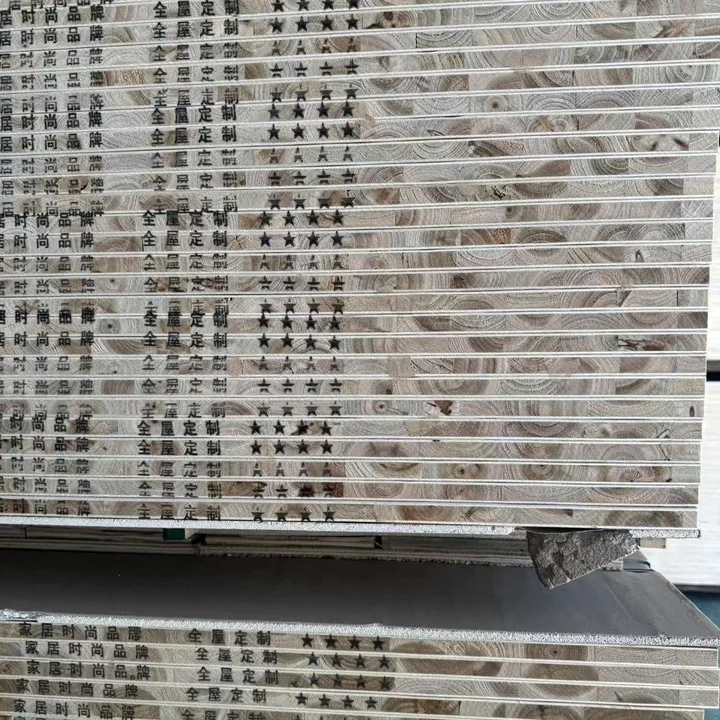
Request a quotation→Blockboard is built the opposite way to plywood: instead of thin veneers, the core is made of softwood battens 7–12 mm wide, edge-glued side by side, then faced with two layers of veneer on each side. The battens run in one direction, which gives the panel very high stiffness along the length while keeping it light — typically 30–40 % lighter than an MDF panel of the same thickness.
That combination — light, stiff, and able to hold a screw driven into the edge — is why blockboard remains the default core for wardrobe doors, interior doors and furniture frames in Europe, the Middle East and North Africa. Huayanwood supplies 15, 16 and 18 mm in 1220 × 2440 mm with fir, poplar or camphor battens and okoume, bintangor, pine or melamine faces.
Specification
| Panel size | 1220 × 2440 mm (4 × 8 ft) |
|---|---|
| Thickness | 15 / 16 / 18 mm — tolerance ±0.5 mm |
| Core | Fir, poplar or camphor battens, 7–12 mm wide, edge-glued |
| Face / back | Okoume, bintangor, pine, melamine faced |
| Glue | MR (E1) standard · WBP phenolic on request |
| Density | Approx. 480–560 kg/m³ |
| Edge | Square edge, sanded; sealed on request |
| Moisture content | 8–12 % |
| Loading | 20GP ≈ 22 m³ · 40HQ ≈ 52 m³ |
Built to a specification, not to a price point.
Screw-holding where it counts
A hinge screwed into the edge of a blockboard door grips solid timber, not resin-bonded flake. That is the single reason blockboard still wins for door blanks and wardrobe fronts.
Light enough to hang
A 18 mm blockboard door is markedly lighter than the same door in MDF, which reduces hinge load and makes large doors practical.
Stiff along the batten direction
Battens give the panel a directional stiffness that resists sagging across a wardrobe opening far better than particle board of the same thickness.
Honest about the limits
Blockboard is an interior panel. Its battens are not rot-resistant, so we do not sell it for bathrooms, exteriors or any permanently damp location — and we say so before you order.
Where it is used
18 mm door blanks, veneered or melamine faced.
Light door cores that take lock blocks and hinges cleanly.
Sides and shelves where weight matters.
16–18 mm shelving with a faced or edge-banded finish.
Light structural panels for demountable systems.
Blockboard · 1220 × 2440 mm
Container data
About 400 sheets of 18 mm
About 950 sheets of 18 mm
Steel strapped, waterproof film, corner protectors
Frequently asked
Anything not covered? Send the specification and we will answer in writing.
Ask a question →Blockboard, plywood or MDF — what is the difference?
Plywood is thin veneers crossed at 90°, strong in both directions. Blockboard is solid battens in one direction, faced with veneer — lighter, stiffer along the battens, and much better at holding a screw in the edge. MDF is homogeneous fibre, best for machining and painting but heavy and poor at edge screws.
Why is blockboard used for doors?
Because hinges and locks need to bite into solid wood. A blockboard door holds a screw in its edge; a particle board or MDF door needs an insert or a special hinge. It is also lighter, so large doors do not overload their hinges.
Can blockboard be used outdoors?
No. We only recommend it for interior, dry applications. Even with WBP glue, the softwood battens are not rot-resistant and the panel will fail in prolonged damp.
Which core is best?
Fir and camphor give the straightest battens and the best screw-holding. Poplar is lighter and slightly softer. Tell us the application — a wardrobe door and a shop fixture do not need the same core.
What is the minimum order and lead time?
One 20GP, roughly 22 m³. Lead time is 20 days from deposit for standard 15–18 mm, with veneer species and melamine decor confirmed at order.
Related series

Send us your specification.
Tell us the face species, core, glue class, size, thickness, quantity and destination port. You will have a written quotation within one working day.